Why is it important for INGOs to politicise their approaches to storytelling and convene spaces for collaboration?

A reflection on ActionAid’s first stories “write-shop”.
On the morning of 9th March 2026, united in purpose and in an enabling learning environment, 30 story weavers1 from 15 countries across the ActionAid Federation gathered in a circular room at MS TCDC (MS Training Centre for Development Cooperation), a space dedicated to learning, leadership and strengthening the people and organisations driving social change across Africa. Located in Arusha Tanzania, the centre provided a welcoming space for participants to learn, exchange experiences and get to know one another. As protocol was observed, we were first welcomed by the leadership of MS TCDC and, unexpectedly, by the monkeys that appeared near the learning space and along its pathways, almost like curious and attentive observers of the learning. They had visited many of us the previous night, dancing over our roofs as we slept! It was a fascinating and memorable experience!
We quickly realised that learning can take different approaches: we started by introducing ourselves through storytelling using an object that deeply touched our lives. In an emotional and fascinated mood everyone had their turn to share. One of the most touching story objects came from our colleague Amish; he presented a letter from his friend who had passed away 30 years ago. “I will always cherish him, his memory, friendship and the experience we shared”, Amish said. Amish keeps the letter as he continues to miss his dear friend. This session reminded us that our storytelling should preserve memories, placing the people we serve at the centre, amplifying their voices, upholding their dignity and creating a long lasting impact.
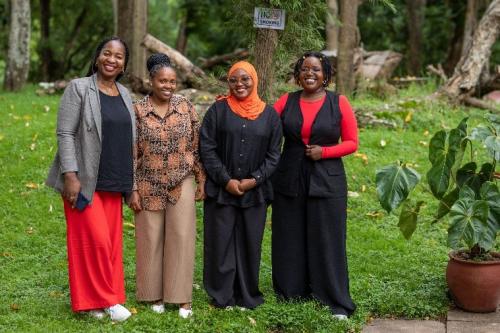
From personal reflections rooted in memory and connection, we moved into practical learning grounded in lived experiences of resilience and community action of ActionAid Tanzania partners. The organising team intentionally invited ActionAid Tanzania to bring their partners to the write-shop to help us learn about their work and encourage us to reflect on the potential power dynamics and collaborative processes between organisations and activist partners when collecting and sharing stories.
Rosina, a farmer from Chamwino district, took us through how, in partnership with ActionAid Tanzania, her colleagues are responding to one of the most pressing negative effects of Climate Change: a semi-arid climate. Building on Chamwino farmers’ traditional farming knowledge, the partnership has empowered women and young farmers to adopt agroecology and climate resilient practices. This has led to a more than 50% increase in crop yields, the building of an agroecological demo farm and the creation of community seed banks, much like those discussed in How to fund transformative projects?.
Their work has seen reduced food production costs, the improved ability of farmers to better cope with rainfall variability, improved access to drought-tolerant seeds and off-session farming and value addition opportunities that generate income and improve households’ earnings.
The experiences of women and youth farmers in Chamwino reminded us that climate resilience must be rooted in equity, partnership, participation and the recognition of the knowledge of local community members whose transformation can only happen when they are empowered as active agents of change of their own future.
We explored the use of digital knowledge for climate information and education for women farmers in a session led by Zakia, a digital Climate Advocate from Tanzania. Her rationale was that Climate Change is widely discussed at global level, yet for many women it remains distant and difficult to understand. Zakia works to bridge that gap using digital means. She launched a digital media platform that makes climate information more accessible, helping women to understand climate change and advocate for climate justice. Zakia’s work made meaningful our Federation Communications Strategy 2026 – 2029, as it prioritises Digital First and Digital Power shift approaches that make our work more accessible.
After hearing from Rosina and Zakia, our colleagues highlighted one of the key goals of the write-shop; to strengthen ActionAid’s storytelling for impact by aligning it with our organisational decolonial, anti-racist and feminist principles. We discussed how colonial approaches to storytelling are shaped by power structures, where voices, local knowledge and experiences are ignored, misrepresented, simplified, or controlled by external actors. Such storytelling reinforces power imbalances, distorts reality and weakens community voices, undermining agency and the dignity of women and marginalised communities.
On the other hand, decolonial storytelling recognises that colonial legacies highlight inequalities, avoids saviour narratives, challenges dominant narratives and center local knowledge and lived experiences. This approach shifts power to communities, promotes dignity and agency, allows the collective exploration of impact, challenges stereotypes and supports change.
“ActionAid is not the hero, we are shifting from ‘what did we do?’ to ‘what changes for people as active agents of change?” – Write-shop Participant
Holding this space for collaboration across the organisation enabled the write-shop to make both strategic and practical progress towards transforming storytelling across the ActionAid federation through a more political, feminist and decolonial approach. It also created space to reflect on the role, power and positionality of story weavers in shaping narratives and challenging inequalities. If stories are to become tools for redistributing power, amplifying community voices and addressing intersectional inequalities, storytelling processes need to be collaborative and participatory.
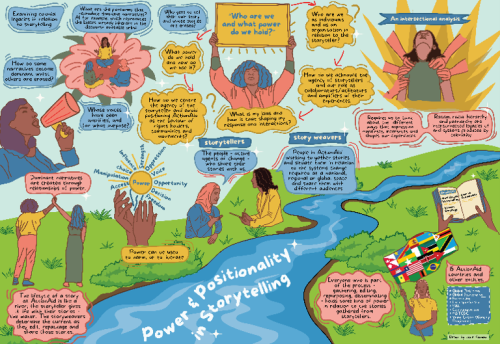
Any change requires a guiding framework. A Stories Framework was collectively developed to guide all stages; from planning and collection, to review and use. Developed with a decolonial and feminist lens, it encourages us to examine our own biases, privileges, positionality and how these may shape our interpretation and engagement with storytellers’ experience. We must ask whether the story upholds anti racist storytelling principles, challenges harmful gender norms and stereotypes and promotes agency and dignity.
All these considerations call for collaboration between teams and functions – communications, fundraising, Global Platforms, programmes, MEL - in order to ensure that the stories collected centre community voices and peoples’ agency and dignity instead of narratives of saviour.
A live podcast brought these issues to the fore. [Link: Ep 49: Why do stories matter in social change work? With ActionAid Global Staff. | TROUBLEMAKERS]. Practical changes since the writeshop include coordinated action through a Federation Stories Strategy working group, and collaboration around shared calendars and approaches in planning and reporting.
Equally important, the write-shop emphasised movement-centric storytelling to amplify movement and partner voices and demonstrate genuine solidarity and shared purpose. Participants committed to pledges to craft stories that are authentic and evidence based, using quotes, relevant data and contextual analysis to connect local lived experiences to broader systemic change. The stories’ collection will continually and strictly comply with safeguarding requirements.
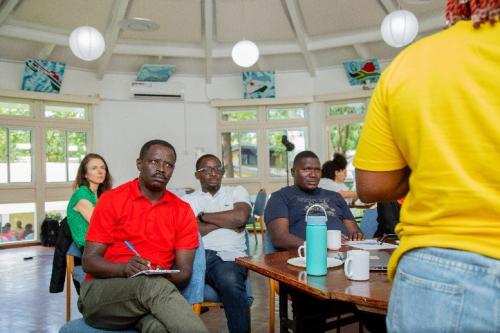
The write-shop wasn’t just a 5-day workshop to learn about documenting stories. It was a long-term investment in capacity building, a space for collective reflection and a step towards building a more political, aligned, ethical and impactful storytelling culture across the federation.
While the impact of the write-shop has begun to emerge and its learnings are being shared across different contexts, story weavers have started reconvening to remind themselves about adopting the learnings and the objective of the write-shop: to strengthen a shared and clear federation wider understanding of ActionAid’s role in storytelling. This includes alignment of storytelling practices with decolonial, feminist and anti-racist values by enhancing coherence in how stories are captured, communicated and used across regions.
And then before we knew it, the write-shop was over. We packed up our belongings, armed with our framework and energised to uphold our commitment to storytelling that amplifies the voices and agency of rights holders. The monkeys swung casually through the trees, watching us go – happy, perhaps, to have the space all to themselves until the next group of dreamers and weavers arrived.