An Invitation to the EU’s COP31 Potluck (Tupperware Not Included)

Imagine COP, the global climate negotiation, as a good old-fashioned potluck dinner. The rules are simple: everyone brings a dish, everyone shares, and the table gets better over time. The EU helped write those dinner rules, constantly reminding everyone to bring bigger portions and share fairly with those who arrive hungry.
Yet this year, the EU is walking into COP31 with a beautifully rehearsed speech about the importance of dinner—and an almost empty Tupperware.
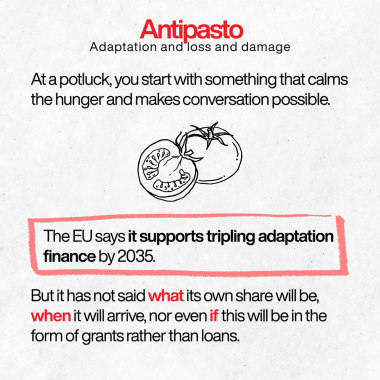
Antipasto: adaptation and loss and damage
At a proper potluck, you do not begin with the heaviest main course. You start with something that calms the hunger and makes conversation possible. That is adaptation and loss and damage: not the whole solution, but the basic decency of acknowledging that some guests have been hit hardest by a storm they did little to cause.
The EU says it supports tripling adaptation finance by 2035. UNEPs’ latest Adaptation Gap report makes clear that even the best interpretation of the vaguely-defined goal will still only address a fraction of the need. But it has not said what its own share will be, when it will arrive, nor even if this will be in the form of grants rather than loans. Meanwhile the Fund for Responding to Loss and Damage is now set up but held back by a lack of resources. That is like praising the antipasto while contributing peanuts – and a half bag at that. Vulnerable countries do not need another compliment about resilience; they need resources, access and delivery.
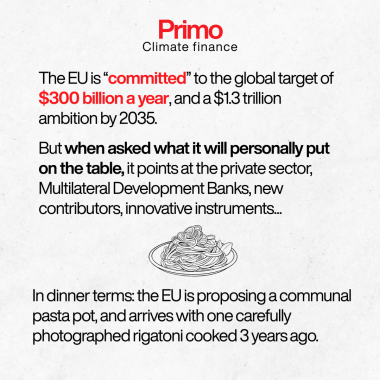
Primo: climate finance
Then comes the primo—climate finance—the pasta that makes the rest of the meal possible. Without it, the secondo is just a lecture about nutrition.
The EU is “committed” to the global target of $300 billion a year, and even the wider $1.3 trillion ambition by 2035. But when asked what it will personally put on the table, it points at the private sector, Multilateral Development Banks, new contributors, innovative instruments and, presumably, the neighbour’s fridge. Basically, count on the EU for the salt, the pepper and possibly some artisanal napkins.
The Council conclusions reaffirm the goals without a quantified EU pathway or interim milestones. In dinner terms: the EU has eaten most of the wheat historically, is now proposing a communal pasta pot, and arrives with one carefully photographed rigatoni cooked three years ago. Meanwhile, it lectures those who arguably invented pasta on how to cook.
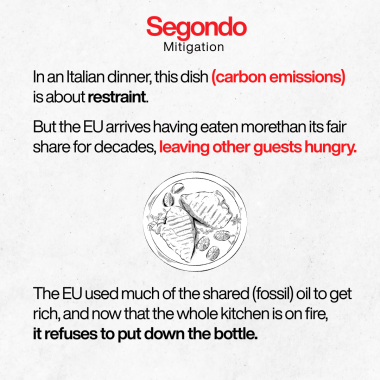
Secondo: mitigation
Finally, the potluck reaches the secondo—mitigation, the main course. In a proper Italian dinner, this dish (carbon emissions) is about restraint: small, clean, and with nowhere to hide. But the EU arrives having eaten more than its fair share for decades, leaving other guests hungry—and it is itself still very hungry.
Worse, it is addicted to the cooking oil. In our global kitchen, that oil is fossil fuels: the quick, dirty ingredient everyone keeps reaching for, and the one that leaves a toxic aftertaste long after the meal is over. The EU used much of the shared oil to get rich, and now that the whole kitchen is on fire, it refuses to put down the bottle.
Instead, the EU behaves like the guest with the largest historical plate policing the buffet: a self-appointed doctor lecturing thinner, hungrier guests to go on a strict, fat-free diet, while its own plans show no real change to shrink its plate, cancel its oil deliveries, or stop paying for extra grease.
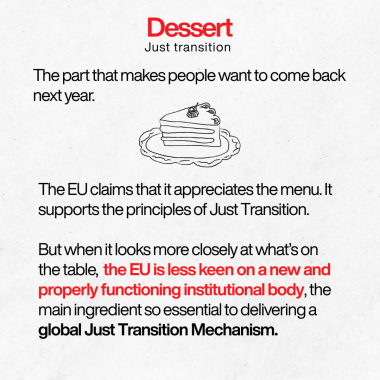
Dessert: just transition
Just transition is the dessert: the part that makes people want to come back next year. It is where workers, communities and countries are told the transition will not simply be done to them, but with them.
Here, the EU claims that it appreciates the menu. It supports the principles of Just Transition—coordination, capacity-building and inclusive participation. But when it looks more closely at what’s on the table, it turns out that the EU is less keen on a new and properly functioning institutional body, the main ingredient so essential to delivering a global Just Transition Mechanism.
Without a new institution to track global efforts, build knowledge, and support implementation, including through a group to better direct funding to the under-resourced activities that ensure a transition is just, the dessert on offer turns out to be icing without a cake.
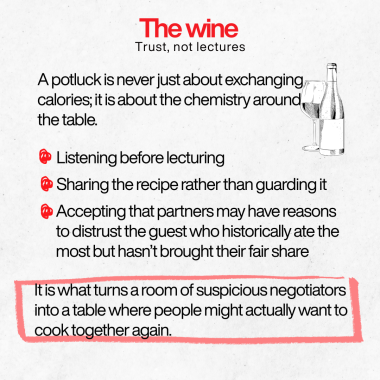
The wine: trust, not lectures
And finally, the wine. A potluck is never just about exchanging calories; it is about the chemistry around the table.
The EU has a habit of arriving with the best slides, the loudest microphone and the certainty that it understands everyone else’s kitchen better than they do. It then seems genuinely surprised when the other guests start cooking together without it. When the countries already carrying the cost of a climate crisis they didn’t cause are denied funding but told they must nonetheless do much more, tempers can flare and trust is in short supply.
The wine is the antidote: listening before lecturing, sharing the recipe rather than guarding it, and accepting that partners may have reasons to distrust the guest who historically ate the most but hasn’t brought their fair share. It is what turns a room of suspicious negotiators into a table where people might actually want to cook together again. Without it, this is not a potluck; it is a catering contract with better lanyards.
No bill at a potluck
There is no bill at a potluck. That is rather the point. Everyone contributes according to what they can bring, and everyone leaves with more than they arrived with.
The EU, however, keeps asking others to cook more, clean faster, and accept smaller portions, while its own contribution remains a fork, a speech and an empty Tupperware with a faint residual smell of ambition.
COP31 is not asking the EU to bring everything. It is asking it to bring its dish: a quantified contribution to the $300 billion goal, a proper share of grant-based adaptation finance, a fossil-fuel phase-out plan at home, and a Just Transition Mechanism with cake actually inside it.
Because if the EU keeps praising the dinner, demanding bigger portions from everyone else, and leaving before the washing-up, our all-important climate get-togethers face an increasingly doubtful future.