International Women’s Day: A call for the next EU budget to promote women's rights, justice and action

International Women’s Day: a call for the next EU budget to promote rights, justice and action for all women and girls.
Brussels decision makers are starting to negotiate one of the most important files for the next years ahead: the EU long-term budget. But in an increasingly aggressive global context — where militarisation, war and competitiveness are taking centre stage in political agendas and capturing the largest share of financing — the EU is facing a defining crossroads: one of values, narratives and identity. At this critical moment, ActionAid’s message is clear: the EU must stand firm in its values and lead the way towards a just and feminist future grounded in dialogue and the peaceful resolution of conflicts.
Yet the Commission’s July 2025 proposal and the direction of negotiations so far reveal a worrying trend. Flexibility, self-interest and simplification are being prioritised over equal partnerships, sustainable development and the fight against poverty. “When we are talking about money, we are talking about power” told MEP Lina Galvez, Chair of the FEMM Committee in the European Parliament, to ActionAid in a recent interview, “and the bad news is that there are not targets, no percentages [for gender equality]. This will depend very much on the political will and the bureaucratic enforcement of this political will”. As negotiations intensify, we must not lose sight of what is at stake. The EU budget is not an abstract political exercise — it shapes real lives, real people in Europe and beyond, and communities like those in Bangladesh, Uganda and Jordan where ActionAid is active to advance gender justice.
Rikta Nurunnahar’s Activism and Civic Engagement Against Child Abuse
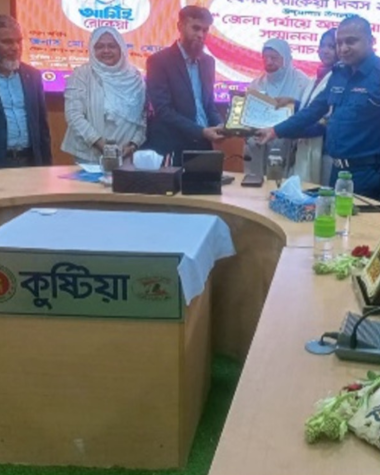
Nurunnahar Rikta is an activist and civil society representative from Kushtia, Bangladesh, who has emerged as a powerful voice against child abuse. In 2024, she took part in youth training on journalistic skills organised by and ActionAid Bangladesh and the Bangladesh Institute of Journalism & Electronic Media. Soon after, she authored a powerful op-ed exposing the silence, neglect and harsh realities surrounding child safety. Published in the national daily Samakal, her article shed light on critical child rights challenges at both local and national levels. The response was immediate. Her piece sparked wide discussion across Kushtia, prompting teachers, parents, local authorities and child rights organisations to engage in renewed and meaningful dialogue on child protection and shared responsibility. In recognition of her work and strong activism, the Kushtia Sadar sub-district administration, with support from the Department of Women Affairs and the Ministry of Women and Children Affairs, honoured Nurunnahar Rikta as “Best Indomitable Woman”.
Rikta’s story goes far beyond a single op-ed; it stands as a powerful example of active civic engagement in advancing child protection and social justice. Her work demonstrates that a conscious and courageous woman can challenge societal barriers and inspire real change—her voice becoming a source of motivation for many.
Building the Foundations for Safe, Inclusive and Sustainable Workplaces
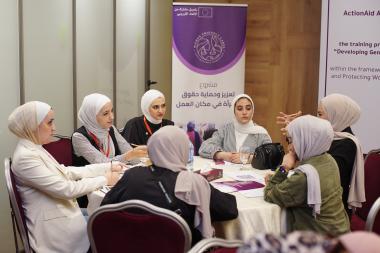
In Jordan, gender discrimination in the workplace is a crucial issue. Jordan has one of the lowest levels of women workers in the world, with female participation in the workplace standing at less than 14 per cent, according to the World Bank. This is despite there being more female university graduates in the country than men. A joint survey by ActionAid and the Maal Centre, which aimed to uncover some of the reasons behind the low rate, found that violence against women in the workplace was one of the most significant factors to blame: one in five women said they had experienced sexual harassment while at work. Other factors include the fact that laws prohibiting gender discrimination in the workplace are not strictly enforced, and legal provisions – such as paid maternity leave – are often ignored by employers. Meanwhile restrictive cultural norms, which dictate that women carry out unpaid care and domestic work, also have an impact.
To change these realities, ActionAid Arab Region’s Women Friendly Label (WFL) initiative[1] is supporting organizations and businesses to take practical steps toward safer, more inclusive, and gender-responsive workplaces – including through the development of a new Women-Friendly Label. Businesses and organisations in Jordan can now be awarded the Women-Friendly Label if they demonstrate that they protect and promote women’s rights in the workplace to a high standard. A core group of women from a range of different backgrounds came together to design the 12 criteria that make up the label, to ensure it genuinely reflected the needs of female employees. Five companies have now become the first to be designated as ‘women-friendly’ environments, setting a good path for other businesses and SMEs to follow.
Boosting Community Action Against FGM and Harmful Practices
In Karamoja, Uganda, harmful practices remain a major barrier to girls’ rights. Half of the girls are married before the age of 18 and many girls drop out of school as a result of early marriage or FGM, and face heightened risks of HIV/AIDS, and lifelong trauma. Despite existing laws, many harmful practices continue in secrecy. For example, FGM is often performed in hiding or across borders to avoid police surveillance, especially in the Karamoja region.
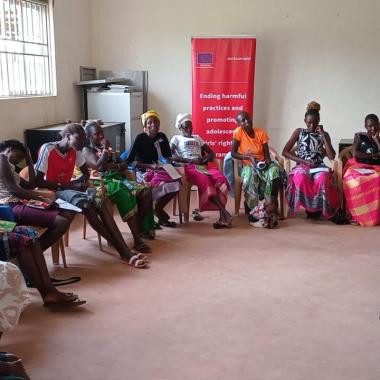
But change is possible and it starts in the communities. Through activities like health outreaches, GBV response services, intergenerational and community dialogues and engagement of cultural and community leaders, ActionAid brought together young women and girls activists in Karamoja for a feminist training, where they exchanged knowledge, skills, and gained confidence to speak up for themselves, advocate for their peers, and challenge gender inequalities in their communities. A similar initiative also gathered 73 local, cultural, religious, youth, and district leaders to discuss how they can use their platforms to advocate against violence against women and end harmful practices.
Change happens when budgets deliver
These stories from Bangladesh, Uganda and Jordan are powerful stories of impact and change in women’s and girls’ lives, as well as testimonies of resistance and resilience of communities against gender discrimination and patriarchal norms. But these impact stories are at risk. The growing anti-gender movement globally, and the extreme cuts to ODA by major global donors have had very severe impacts on gender equality: as UN Women found, one out of three surveyed WROs and CSOs have suspended or shut down programmes aimed at ending gender-based violence, due to aid cuts.
In this context, the EU and its Member states, as the world’s largest providers of ODA, have a crucial responsibility in the negotiations for the next budget to preserve, protect and expand funding for the promotion of gender equality and women’s empowerment. “We need to rethink and to review how this money is spent, otherwise we won’t advance on gender equality. We need good methodology, good data and political will. For global action it’s also crucial: unless we put money on global aid, a lot of women NGOs will not have funds now that the US has withdrawn, so this is central and we will definitely work for it” says MEP Galvez. At a time when power and money are being used to push an anti-gender and patriarchal vision of the world, the EU needs to centre the voice of local feminist movements and WROs calling for rights, justice and action.
[1] The trainings were organised by ActionAid Bangladesh in the framework of the project Supporting the Unity and Sustainability of Civil Society Organizations (CSOs) to uphold Human Rights, National Integrity and Rule of Law in Bangladesh (SUSHIL), co-funded by the European Union and the Haramead Trust.
[2] The initiative is co-funded by the European Union.
[3] The activities presented are part of the project Ending Harmful Practices and Promoting Adolescent Girls’ Rights in Karamoja, co-funded by the European Union and implemented by ActionAid Uganda. See more here: EU FUNDS €600,000 INITIATIVE TO PROMOTE GIRLS’ RIGHTS IN KARAMOJA | ActionAid International Uganda